Introduction
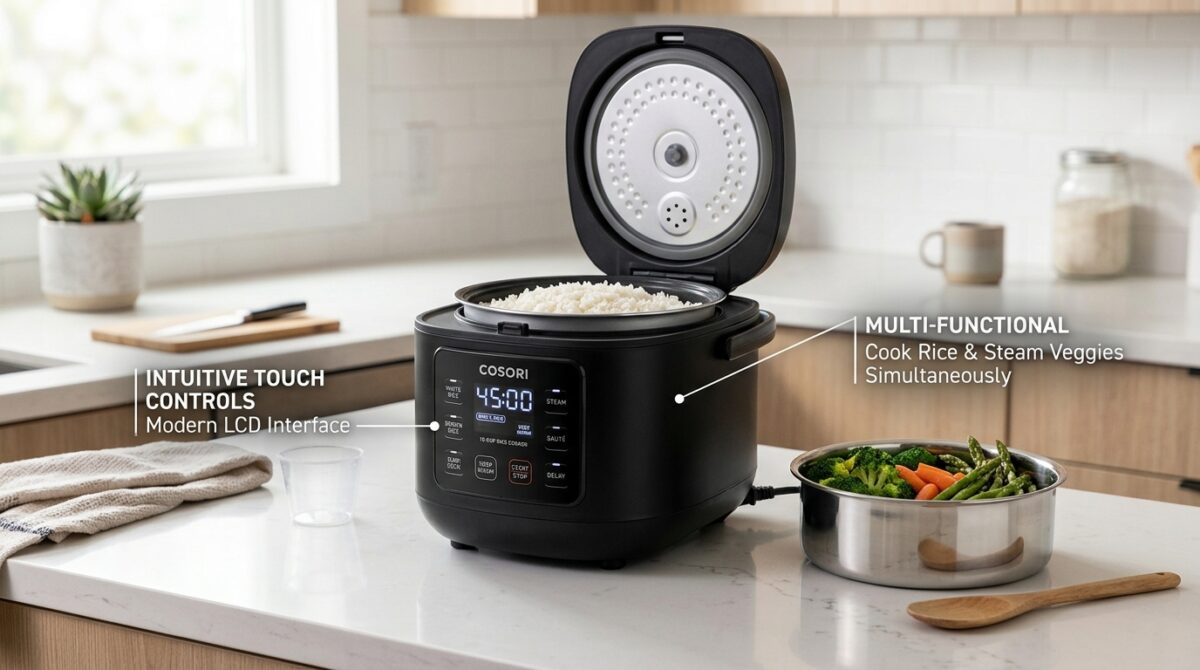
Rice cookers have quietly become one of the more versatile appliances in a lot of kitchens, moving well past their original single job of just cooking rice. The Cosori 10-Cup Rice Cooker leans into that shift, combining a larger cooking capacity with fuzzy logic technology, 18 different functions, and a ceramic non-stick interior, positioning itself less as a basic rice pot and more as a small multicooker built around a rice-cooking core. This article goes through what the unit actually offers, how its various functions tend to get used, who it fits best, and a handful of practical things worth thinking through before it earns a spot on your counter.
As with the other breakdowns in this series, the point here isn’t to crown this the definitive best rice cooker on the market — it’s to lay out what it does clearly enough that you can decide if it matches how you actually cook.
Key Features
10-cup capacity. This is a larger-than-average size for a rice cooker, generally suited to bigger households, regular meal prepping, or families who go through rice or grains frequently and don’t want to run multiple batches.
Fuzzy logic technology. This refers to a more advanced control system than a basic timer-and-heat rice cooker, where the appliance adjusts cooking time and temperature in response to conditions like rice type and moisture content, aimed at producing more consistent results across different kinds of rice and grains.
18 functions. Beyond standard white or brown rice settings, the unit includes a wide range of programmed functions, extending its role into sautéing, slow cooking, and other grain or dish-specific settings, which is a notably broad range for this category of appliance.
24-hour keep warm. The keep-warm function is rated for a full 24 hours, considerably longer than the shorter keep-warm windows found on more basic rice cookers, which is relevant for households with staggered mealtimes or unpredictable schedules.
Non-stick ceramic inner pot. The cooking pot uses a ceramic non-stick coating, which is generally chosen both for easier food release and cleanup, and because ceramic coatings are often marketed as a chemical-conscious alternative to some traditional non-stick coatings.
Stainless steel steamer basket. Included with the unit is a steamer basket, allowing vegetables, proteins, or other foods to be steamed alongside rice cooking or used independently of the rice function.
Sauté function. A built-in sauté setting allows for browning aromatics, vegetables, or meat directly in the same pot before switching to a cooking or slow-cook function, reducing the need for a separate pan for that step.
Slow cooker function. Beyond rice and grains, the unit can also function as a slow cooker, extending its versatility into longer, low-and-slow cooking methods typically associated with dedicated slow cooker appliances.
How It Can Be Used
The core function remains cooking rice and grains, but the fuzzy logic system is generally what sets this apart from more basic rice cookers — rather than applying one fixed cooking program regardless of rice type, it’s designed to adjust based on the specific conditions of what’s being cooked, aiming for more consistent texture whether it’s white rice, brown rice, or other grains.
The sauté function is commonly used at the start of a recipe, allowing onions, garlic, or other aromatics to be browned directly in the pot before adding liquid and switching to a cooking or simmering function, which streamlines certain one-pot recipes that would otherwise require a separate stovetop pan.
The steamer basket is generally used either during rice cooking, to steam vegetables or proteins above the rice at the same time, or independently, for tasks like steaming dumplings or fish fillets without needing to run the rice-cooking function at all.
The slow cooker function extends the appliance’s use into dishes like stews, chili, or slow-braised meats, which is a meaningfully different use case from quick rice cooking and positions the unit as more of an all-around cooking appliance for households wanting to consolidate tools.
The 24-hour keep-warm setting is generally used by households with less predictable mealtimes, where rice made earlier in the day needs to stay at a safe, ready-to-eat temperature well past the initial cooking cycle without needing to be reheated separately later.
With 18 total functions, many users spend some initial time exploring the different presets to figure out which ones get used regularly versus which remain more occasional, since a function list this extensive naturally includes some settings that see more frequent use than others depending on individual cooking habits.
Who It May Be Suitable For
Larger households or those who cook rice frequently. The 10-cup capacity is generally well suited to bigger families or anyone who regularly needs a larger batch of rice or grains without running multiple cooking cycles.
People who want to consolidate multiple small appliances. Between the sauté, slow cooker, and steaming functions, this unit may appeal to those hoping to reduce the number of separate appliances — a slow cooker, a steamer, a sauté pan — cluttering their kitchen.
Meal preppers. The combination of larger capacity and extended keep-warm time may suit those who cook larger batches in advance and eat from them over the course of a day or more.
Households wanting more consistent rice results. The fuzzy logic system is particularly relevant for anyone who has struggled with inconsistent texture using a more basic rice cooker, especially when cooking different types of rice or grains interchangeably.
Those interested in a ceramic non-stick interior. Buyers specifically looking for a ceramic-coated pot, as opposed to a traditional non-stick coating, may find this a relevant distinguishing feature.
Smaller households or individuals cooking primarily single servings may find a 10-cup capacity larger than necessary, and a more compact personal or smaller-capacity rice cooker could be a more practical and space-efficient choice in that case.
Important Things to Consider
Physical size relative to capacity. A 10-cup rice cooker is a larger appliance overall, so measuring available counter and storage space is worth doing before committing to this size, particularly for smaller kitchens.
Learning curve with 18 functions. With this many programmed settings, there’s a reasonable amount of initial exploration needed to understand which functions are most relevant to your typical cooking, and some functions may end up rarely used depending on personal habits.
Ceramic coating maintenance. While ceramic non-stick coatings are generally durable, using non-metal utensils and following manufacturer cleaning guidance is generally recommended to preserve both the coating’s non-stick performance and its appearance over time.
Extended keep-warm and food quality. While a 24-hour keep-warm function is convenient, most rice cooker manufacturers still note that food quality and texture can gradually shift the longer something sits on keep-warm, even though it remains safe to eat within the rated time frame.
Not identical to a dedicated slow cooker or standalone steamer. While the added slow cook and steaming functions are genuinely useful, a rice cooker offering these as secondary functions generally won’t match the capacity or specialized design of a dedicated, standalone slow cooker or steamer built solely around that single task.
Water and rice ratio adjustments. Even with fuzzy logic technology handling some adjustments automatically, achieving consistent results still generally benefits from following recommended rice-to-water ratios for the specific type of rice or grain being cooked.
Comparison of General Categories
Fuzzy logic, multi-function rice cookers, the category this model belongs to, generally aim to combine more advanced, adaptive cooking technology with a broader range of built-in functions, appealing to those wanting more consistency and versatility from a single appliance.
Basic, single-function rice cookers are simpler and typically less expensive, focused purely on cooking rice with a straightforward on/keep-warm cycle, suited to those who don’t need grain variety, sautéing, or slow-cooking capability.
Pressure cooker multicookers offer a different, faster cooking method through pressure rather than standard steaming or boiling, generally including a similarly broad range of functions but built around a different core cooking mechanism than a fuzzy logic rice cooker.
Dedicated slow cookers are built solely around low, extended cooking times, generally offering larger capacity for that specific purpose compared to the slow-cook function on a multi-purpose rice cooker.
Dedicated steamers are similarly built solely for steaming, typically offering more surface area and steaming capacity than the smaller basket included with a rice cooker like this one.
The right category generally comes down to how much variety is wanted from a single appliance, typical batch sizes, and whether functions like sautéing or slow cooking are genuine priorities alongside core rice and grain cooking.
Frequently Asked Questions
How much rice can this cooker prepare at once? It’s designed for up to 10 cups, making it well suited to larger households or those who regularly cook bigger batches of rice or grains.
What does fuzzy logic technology actually do? It allows the cooker to adjust cooking time and temperature based on the specific rice type and conditions, aiming for more consistent results compared to a fixed, one-size-fits-all cooking cycle.
Can this rice cooker be used for dishes other than rice? Yes, with 18 total functions, including sauté and slow cook settings, it’s built to handle a range of dishes beyond plain rice, such as stews, sautéed vegetables, or other grains.
How long can rice stay on the keep-warm setting? It includes a 24-hour keep-warm function, considerably longer than the shorter keep-warm windows found on more basic rice cookers.
Does it include a way to steam food separately from rice? Yes, a stainless steel steamer basket is included, which can be used alongside rice cooking or independently for steaming vegetables, proteins, or other foods.
Is the inner pot easy to clean? The non-stick ceramic coating is generally designed to ease food release and cleanup, though using non-metal utensils and following care instructions is recommended to maintain the coating over time.
Is this rice cooker suitable for a single person or small household? Given its 10-cup capacity, it’s generally better suited to larger households or frequent batch cooking, and a smaller-capacity or personal rice cooker may be more practical for individual use.
Conclusion
The Cosori 10-Cup Rice Cooker combines a larger cooking capacity with fuzzy logic technology, an extensive 18-function range, and a ceramic non-stick interior, positioning it as a fairly comprehensive multicooker built around a rice-cooking core. Its included sauté and slow cook functions, along with the steamer basket and extended 24-hour keep-warm setting, are aimed at consolidating multiple cooking tasks into a single, larger-capacity appliance.
Whether this specific model fits a given kitchen depends on typical household size, how often larger batches of rice or grains are needed, and how much value is placed on additional functions like sautéing and slow cooking within the same unit. For larger households or those looking to reduce the number of separate cooking appliances in their kitchen, the Cosori 10-Cup Rice Cooker offers a fairly well-rounded set of features built around everyday, higher-volume cooking needs.