Introduction
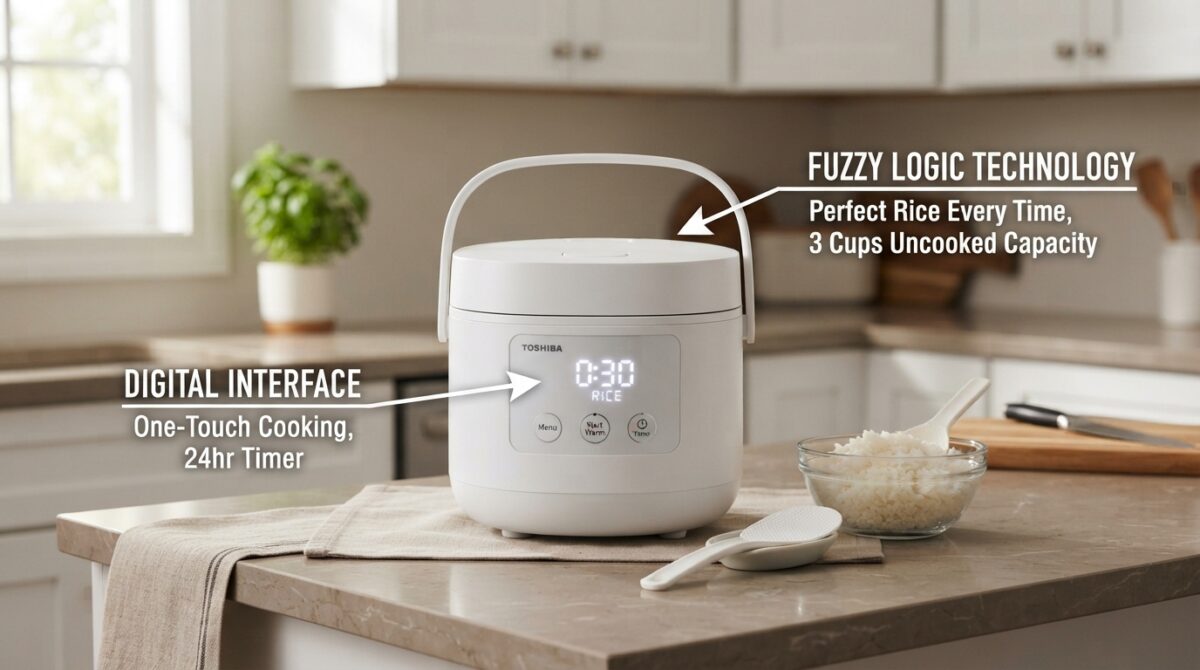
Not every household needs a large rice cooker built around family-sized batches. The Toshiba Mini Rice Cooker takes the opposite approach, offering a 3-cup uncooked capacity aimed at smaller households, individuals, or anyone who simply doesn’t need a bigger unit taking up counter space. Despite its smaller size, it still includes fuzzy logic technology, one-touch cooking, a 24-hour delay timer, and automatic keep-warm functionality — features more often associated with larger, more advanced rice cookers. This article looks at what the Toshiba Mini actually offers, how it tends to be used, who it fits best, and a few practical points worth thinking through before it earns a spot in your kitchen.
As with the other appliance breakdowns in this series, the goal here isn’t to declare this the definitive best small rice cooker on the market, but to walk through its features clearly enough that you can weigh them against your own portion needs and daily routine.
Key Features
3-cup uncooked capacity. This puts the unit solidly in the compact category, generally translating to a cooked yield suited to one to three people, depending on portion size and whether rice is a main component of the meal or a side dish.
Fuzzy logic technology. Rather than relying on a single, fixed cooking cycle, fuzzy logic systems generally adjust cooking time and heat based on the specific rice type and moisture conditions, aiming for more consistent texture compared to a basic, one-size-fits-all cooking program.
One-touch cooking. The unit is designed for simple operation, generally requiring just a single button press to start the cooking cycle, which keeps the day-to-day experience straightforward rather than requiring multiple setting selections.
24-hour delay timer. This feature allows cooking to be scheduled up to a full day in advance, letting rice start cooking, and finish, at a specific time chosen ahead of time rather than needing to start the process manually right when it’s needed.
Auto keep-warm function. Once cooking finishes, the unit automatically switches to a keep-warm setting, holding rice at a safe, ready-to-eat temperature until it’s time to serve, without requiring a separate reheating step.
Steaming function. Beyond just cooking rice, the unit includes a steaming capability, generally used with an included tray or insert for vegetables or other foods prepared alongside the rice.
Compact, mini form factor. The overall physical size is smaller than a standard rice cooker, which is the core appeal for anyone with limited counter or storage space, or simply cooking smaller quantities on a regular basis.
White finish. The exterior comes in a white finish, which is a fairly common and versatile color choice for smaller kitchen appliances meant to blend into a variety of kitchen aesthetics.
How It Can Be Used
The core use, as with any rice cooker, is preparing rice without needing to monitor a pot on the stove, but the smaller 3-cup capacity makes this particularly well suited to individual meals or cooking for just a couple of people rather than a larger family batch.
The fuzzy logic system comes into play across different rice types, generally adjusting the cooking process depending on whether white rice, brown rice, or another grain is being prepared, aiming for consistent results without requiring the user to manually fine-tune settings for each type.
One-touch operation is generally used for the simplest, most frequent version of the task — add rice and water, press the button, and let the unit handle the rest, which suits those who want a quick, low-effort process for a task they repeat often.
The 24-hour delay timer is commonly used by people who want rice ready at a specific time without being present to start the cooking cycle themselves — for example, setting it before leaving for work so rice is finished and ready by the time dinner needs to be prepared.
The auto keep-warm function is generally used any time there’s a gap between when rice finishes cooking and when it’s actually eaten, which is a common enough occurrence that this feature tends to get used almost automatically as part of routine operation.
The steaming function is generally used to prepare a vegetable side or protein alongside the rice, letting a simple meal come together using just the one appliance rather than requiring a separate steaming pot.
Who It May Be Suitable For
Individuals or couples. The 3-cup capacity is generally well matched to smaller households, where a full-size rice cooker’s larger capacity would go mostly unused on a regular basis.
People with limited kitchen space. The compact, mini design is a natural fit for smaller kitchens, dorm rooms, or secondary living spaces where a bigger appliance simply wouldn’t fit comfortably.
Those who want advanced features without a larger unit. Because it still includes fuzzy logic, a delay timer, and keep-warm functionality, this model may appeal to those who want more than a bare-bones mini cooker, without needing the larger capacity that typically comes bundled with those features.
People with predictable schedules who like advance planning. The 24-hour delay timer suits those who prefer to set things up in advance, such as scheduling rice to finish right around a typical dinner time without needing to be home to start the process.
Anyone wanting a simple, low-maintenance rice cooking experience. The one-touch operation keeps day-to-day use straightforward, which may appeal to those who don’t want to deal with a complicated set of manual settings for a task that ideally should be quick and easy.
Larger households or those who regularly cook for more than a few people would likely find the 3-cup capacity too limiting for consistent use, and a standard or larger-capacity rice cooker would generally be a more practical choice in that case.
Important Things to Consider
Capacity limits for anything beyond small portions. It’s worth being realistic about typical rice consumption before choosing this size, since 3 cups uncooked is meaningfully smaller than standard household rice cookers and isn’t intended for larger family meals.
Steaming tray size relative to the unit. As is generally true with compact rice cookers, the included steaming accessory is sized to match the smaller unit, so it’s better suited to modest portions of vegetables or a small protein piece rather than larger quantities.
Delay timer and food safety considerations. When using a delay timer, it’s worth being mindful of how long rice and water sit together before cooking begins, since food safety guidance generally recommends not leaving raw rice in water for extended periods at room temperature before the cooking cycle starts.
Keep-warm duration and rice quality. As with most rice cookers, extended time on keep-warm can gradually affect texture, even though the auto keep-warm function is generally intended for safe, short-to-medium term holding rather than indefinite storage.
Non-stick interior care. Regular, gentle cleaning with non-abrasive tools is generally recommended to preserve the interior cooking surface and maintain consistent performance over the appliance’s lifespan.
Simplicity trade-offs. While one-touch operation and a compact design offer convenience, those wanting more manual control over cooking settings for very specific recipes may find a slightly more feature-rich, larger unit better suited to that kind of experimentation.
Comparison of General Categories
Compact, mini rice cookers with advanced features, the category this model belongs to, aim to combine smaller capacity with more sophisticated cooking technology like fuzzy logic and delay timers, generally suited to individuals or small households wanting more than a bare-bones mini cooker.
Basic mini rice cookers typically skip more advanced features like fuzzy logic or delay timers, focusing purely on a simple, smaller-capacity cooking cycle, often at a lower price point.
Standard-capacity rice cookers (4–8 cups) are better suited to small to medium households needing to cook for multiple people or wanting leftovers, generally at a larger physical size than a mini unit.
Personal, single-serving rice cookers go even smaller than this model, focusing specifically on individual portions rather than the slightly larger 3-cup range offered here.
Stovetop rice cooking remains a no-appliance alternative for any portion size, offering full manual control but requiring more attention to avoid under- or overcooking, which can be especially easy to do with smaller quantities.
The right category generally comes down to typical household size, how much value is placed on advanced features like delay timers and fuzzy logic technology, and how much kitchen space is realistically available for a dedicated rice cooking appliance.
Frequently Asked Questions
How much rice can the Toshiba Mini Rice Cooker prepare at once? It’s designed for up to 3 cups of uncooked rice, generally suited to individual servings or small households of one to three people.
What does fuzzy logic technology do in a compact rice cooker like this one? It generally adjusts cooking time and temperature based on the specific type of rice being prepared, aiming for more consistent results compared to a fixed, one-size-fits-all cooking cycle.
How does the 24-hour delay timer work? It allows cooking to be scheduled up to 24 hours in advance, so rice can finish cooking at a specific time chosen ahead of time rather than needing to start the process manually right when it’s needed.
Does it include a steaming function? Yes, the unit includes steaming capability, generally used with an included tray for vegetables or other foods alongside rice cooking.
What happens after the rice finishes cooking? The unit automatically switches to a keep-warm setting, maintaining a safe, ready-to-eat temperature until the rice is served.
Is this suitable for larger households? Given its 3-cup capacity, it’s generally better suited to smaller households or individual servings, and a larger-capacity rice cooker would be more practical for bigger families or regular batch cooking.
Is one-touch cooking difficult to learn? No, one-touch operation is designed to be simple, generally requiring just a single button press to start the cooking cycle without needing to navigate multiple manual settings.
Conclusion
The Toshiba Mini Rice Cooker combines a compact, 3-cup capacity with features more commonly found on larger rice cookers, including fuzzy logic technology, a 24-hour delay timer, one-touch cooking, and automatic keep-warm functionality. It’s built specifically for smaller households or individual use, without sacrificing the more advanced cooking technology that helps produce consistent results.
Whether this specific model fits a given kitchen depends on typical portion needs, available counter space, and how much value is placed on scheduling flexibility and consistent cooking performance in a smaller-capacity unit. For individuals or small households looking for a compact rice cooker that doesn’t skimp on useful features, the Toshiba Mini offers a fairly well-rounded set of capabilities scaled specifically to smaller everyday needs.