Introduction
Rice cookers are one of those kitchen appliances that don’t get much attention until you actually own one, and then suddenly you wonder how you ever managed without it. The AROMA Digital Rice Cooker, model ARC-914SBD, is a mid-sized digital unit built for households that want reliable, hands-off rice cooking along with a bit of extra versatility for steaming and other grain-based dishes. It isn’t trying to be a flashy, do-everything gadget — it’s a fairly focused appliance aimed at one core job, done well, with a few useful extras layered on top.
This article walks through what the ARC-914SBD actually offers, how people tend to use it day to day, who it fits best, and a few things worth thinking about before it lands on your counter. None of this is meant as a sales pitch — just a straightforward look at the appliance so you can decide for yourself whether it makes sense for your kitchen.
Key Features
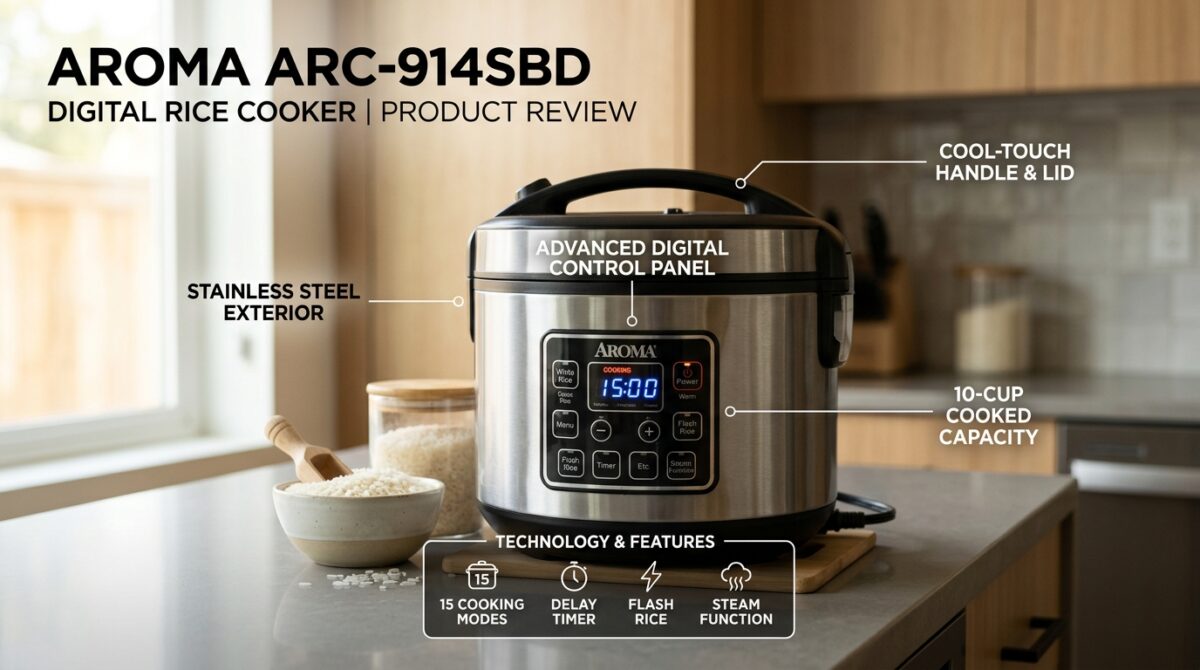
4-cup uncooked / 8-cup cooked capacity. The sizing here is worth paying attention to, since rice cooker capacities are almost always listed in terms of uncooked rice, and the cooked yield roughly doubles once water is absorbed. An 8-cup cooked output generally covers a small to medium household, or enough rice for a family meal with some left over.
Digital controls. Rather than a simple mechanical switch, the ARC-914SBD uses a digital interface, which typically allows for more precise selection between different cooking modes rather than a single one-size-fits-all setting.
Multicooker functionality. Beyond plain white rice, the unit is built to handle a range of grains, and it includes a steaming function as well, positioning it as something closer to a small multicooker than a single-purpose rice pot.
Stainless steel exterior. The outer housing is stainless steel, which tends to hold up well over years of daily use and generally looks a bit more at home on a counter than an all-plastic unit.
2-quart pot size. The internal cooking pot is sized at 2 quarts, which lines up with the stated capacity range and gives a sense of how much physical space the unit will occupy relative to its output.
Steamer tray or insert. Along with cooking rice, the unit is designed to steam vegetables, fish, or other foods, either at the same time as the rice is cooking or as a separate function, depending on how it’s used.
Automatic keep-warm function. Like most rice cookers in this category, it’s built to automatically switch to a keep-warm setting once cooking finishes, so rice doesn’t need to be eaten immediately or reheated separately if a meal is delayed.
How It Can Be Used
The most obvious and frequent use is exactly what it sounds like — cooking white rice, brown rice, or other grains as a base for a meal, without needing to babysit a pot on the stove or guess when it’s done. You add rice and water, select the appropriate setting, and the machine handles the rest, switching to keep-warm automatically once finished.
Because it’s marketed as a multicooker rather than a strict rice-only appliance, it’s also commonly used for grains like quinoa or other rice alternatives, expanding its role a bit beyond the most basic use case. The specific settings available on the digital panel are generally what determine how many different grain types it can handle well.
The steaming function tends to get used alongside rice cooking, where vegetables or proteins are steamed in a tray above the rice as it cooks, letting an entire side dish or partial meal come together in one appliance without extra pots. Some people also use the steaming function on its own, separate from cooking rice, for things like steamed dumplings or fish fillets.
The keep-warm setting is one of those quiet, background features that ends up mattering more than expected in daily use — it means rice made in the morning or early afternoon is still warm and ready to eat come dinner, without needing to microwave it back to temperature or worry about it drying out on the counter.
Who It May Be Suitable For
Small to medium households. Given the 4-cup uncooked / 8-cup cooked range, this unit generally suits a household of two to four people fairly comfortably, with some flexibility for leftovers or slightly larger gatherings.
People who eat rice or grains regularly. For anyone who has rice as a staple side dish several times a week, a dedicated rice cooker tends to save a meaningful amount of time and mental effort compared to managing it on the stovetop.
Those who want a bit of extra functionality without a full multicooker. Because it includes steaming and a range of grain settings, it may appeal to people who want more than a bare-bones rice cooker, but don’t necessarily need the full range of functions found in larger pressure-cooker-style multicookers.
People who value simple, hands-off cooking. The digital, mostly automated nature of the appliance suits those who want to set it and walk away rather than actively monitor cooking progress.
Larger households needing to cook rice in bulk regularly, or those who specifically want pressure-cooking functionality (for things like beans or tougher cuts of meat), may find a bigger-capacity or pressure-cooker-style multicooker better suited to those particular needs.
Important Things to Consider
Capacity limits for larger gatherings. While 8 cups cooked is reasonable for everyday use, anyone regularly cooking for larger groups may find themselves needing to run the cooker more than once, or may want to consider a larger-capacity model instead.
Digital interface learning curve. Digital controls generally offer more precision than a simple mechanical switch, but they also mean a slightly longer initial learning period to understand which setting corresponds to which grain or cooking style.
Steaming tray capacity. Steaming trays included with rice cookers are typically sized modestly, since they sit above the rice pot rather than replacing it, so very large quantities of vegetables or protein may not fit comfortably in a single steaming session.
Non-stick pot maintenance. As with most rice cooker pots, gentle cleaning tools are generally recommended to avoid scratching any non-stick coating, since scratches can affect both cooking performance and the coating’s lifespan over time.
Counter space for a stainless steel unit. While not an oversized appliance, a stainless steel rice cooker with a lid and steaming tray does take up a dedicated spot on the counter, which is worth factoring into kitchen layout, especially in smaller spaces.
Keep-warm duration. While the keep-warm function is convenient, most rice cookers recommend not leaving rice on keep-warm indefinitely, since texture and quality can gradually decline the longer it sits, even while staying warm and technically safe to eat.
Comparison of General Categories
Digital rice cookers with multicooker features, the category this model fits into, generally balance simplicity with a bit of added versatility, offering more than a single-setting rice cooker without the complexity of a full pressure-cooking multicooker.
Basic, single-setting rice cookers are simpler and often less expensive, focused purely on cooking rice with a basic on/off or keep-warm switch, suited to those who don’t need grain variety or steaming functions.
Pressure cooker multicookers (like larger Instant Pot-style appliances) offer a broader range of functions, including pressure cooking for beans, meats, and stews, generally at a larger size and higher price point, aimed at those wanting one appliance to handle a wide variety of cooking tasks beyond just rice and grains.
Stovetop rice cooking remains the traditional, no-appliance alternative, offering full manual control but requiring more attention and timing precision to avoid undercooking, overcooking, or burning rice at the bottom of the pot.
Standalone steamers are built solely around steaming, generally offering more steaming capacity than the tray-based steaming function found on most rice cookers, but without the added rice-cooking capability.
The right category generally depends on how much variety is wanted from one appliance, typical batch sizes needed, and whether steaming or pressure-cooking functions are priorities alongside basic rice preparation.
Frequently Asked Questions
How much rice can the ARC-914SBD cook at once? It’s designed for up to 4 cups of uncooked rice, which generally yields around 8 cups once cooked, suited to small to medium households.
Can it cook grains other than white rice? Yes, as a multicooker-style rice cooker, it’s generally built to handle a range of grains beyond plain white rice, along with a dedicated steaming function.
Does it include a steaming tray? Yes, the unit includes steaming functionality, generally used for vegetables, fish, or other foods either alongside rice cooking or as a separate function.
What happens once the rice finishes cooking? Like most rice cookers in this category, it automatically switches to a keep-warm setting once the cooking cycle finishes, keeping rice warm until it’s ready to be served.
Is the exterior easy to maintain? The stainless steel exterior is generally straightforward to wipe down, though the interior non-stick pot benefits from gentler cleaning tools to avoid scratching the coating over time.
Is this suitable for large families or big batch cooking? For very large households or frequent bulk cooking, a bigger-capacity rice cooker may be more practical, since this model is generally sized for smaller to medium household needs.
Does keeping rice warm for a long time affect its quality? Extended time on keep-warm can gradually affect rice texture, so while it’s convenient for a few hours, most rice cookers, including this type, aren’t intended for indefinite warm-holding without some quality trade-off.
Conclusion
The AROMA Digital Rice Cooker (ARC-914SBD) is built around dependable, everyday rice and grain cooking, with digital controls, a steaming function, and a stainless steel exterior rounding out its feature set. It isn’t trying to be an all-in-one kitchen powerhouse — it’s a focused appliance aimed at making one of the most common cooking tasks easier and more consistent, with a bit of added flexibility for steaming and grain variety.
Whether it fits your kitchen really comes down to how often rice or grains show up on your table, how many people you’re typically cooking for, and how much you value hands-off, automated cooking over stovetop methods. For households looking for a reliable, mid-capacity rice cooker with a bit of extra functionality, the ARC-914SBD offers a solid, no-nonsense set of features built around everyday use.